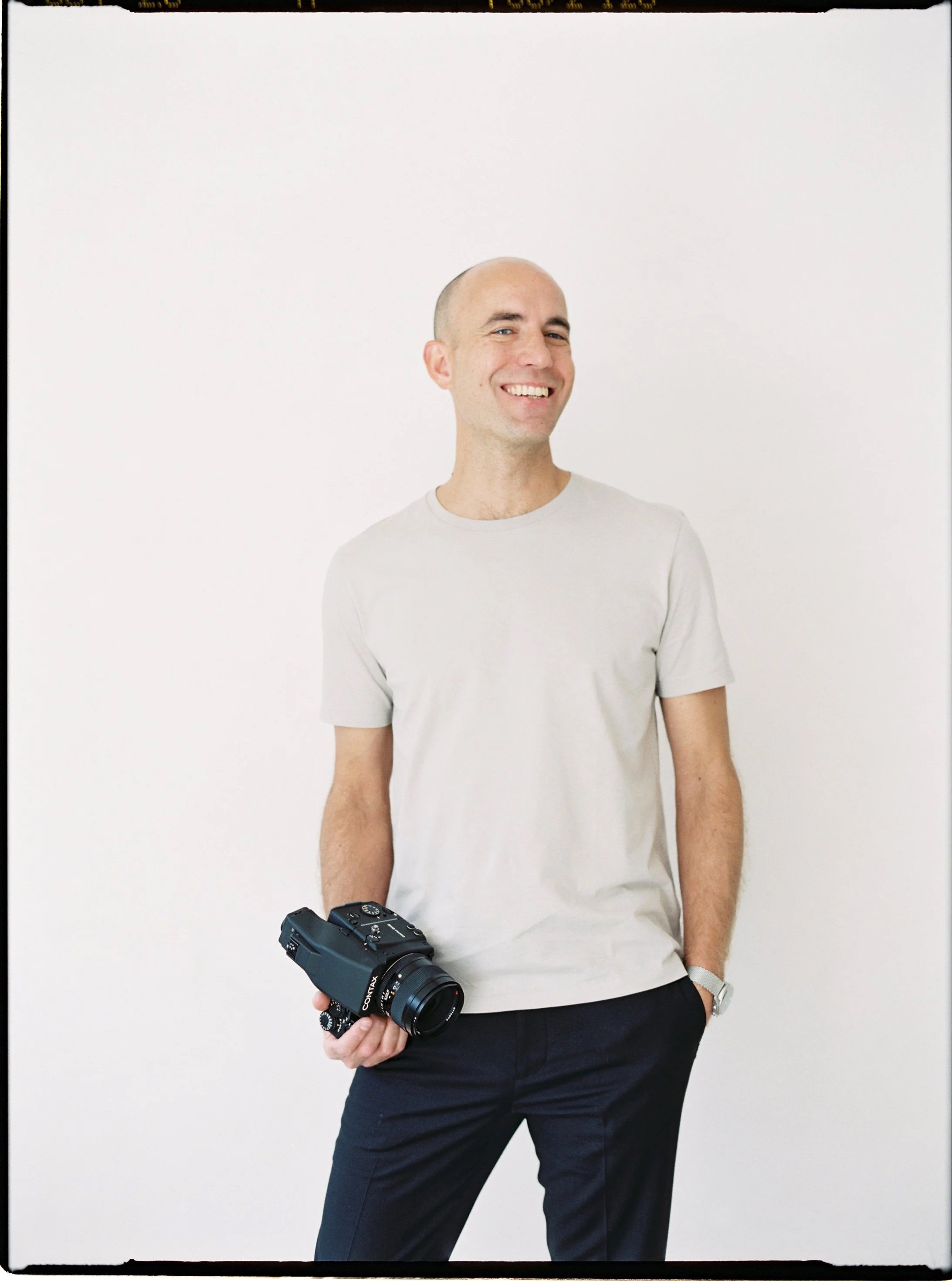
Juan Pinnel is a photographer and filmmaker born in Buenos Aires, Argentina, and currently based in California. His practice unfolds across still and moving image and is shaped by an ongoing inquiry into attention, place, identity, and artistic process. Working between commissioned and self-initiated projects, he is interested in how artistic language develops over time and how context influences perception.
He holds a Bachelor’s degree in Media Studies from Universidad Austral and studied cinematography at Universidad del Cine in Buenos Aires. In his early years working with photochemical photography, he built and operated his own darkroom, establishing a material relationship with image-making that continues to inform his practice. For over two decades, he has worked across documentary filmmaking, television production, music videos, short films, and commercial photography, moving between roles as director, cinematographer, and technical positions within larger productions, including work as gaffer, electrician, and camera crew.
His short film Tigre (2009) screened internationally, including at BAFICI, IndieLisboa, and the Cinémathèque Française in Paris. Between 2010 and 2011, he developed the photographic series Por debajo del sendero, exhibited at Centro Cultural San Martín in Buenos Aires. As a cinematographer, he worked on documentary and cultural productions for Canal Encuentro, including Grandes Músicos de Latinoamérica, featuring artists such as Gilberto Gil, Caetano Veloso, Silvio Rodríguez, and Rubén Blades. He was cinematographer of the online series Embarcados, which received the Martín Fierro Award for Best Online Series, and did the cinematography for the music video Aparecen cuando bailamosfor the Argentine band Catupecu Machu, nominated for an MTV Video Music Award Latin America.
Between 2012 and 2015, he lived and volunteered at a Buddhist retreat center in California. Sustained contemplative practice during this period introduced questions that continue to inform his work: how attention operates in image-making, whether presence can be communicated through form, and what it means to look without imposing narrative or certainty.
Since 2015, he has been based in California, working as a freelance photographer and filmmaker while sustaining an independent artistic practice. Over the past three years, he has returned with renewed intensity to analog and photochemical processes, deepening his engagement with material experimentation and extended darkroom practice. In parallel, he has been developing new screenwriting projects and participating in screenwriting workshops, expanding his investigation into narrative form alongside his photographic and professional work.
He is currently developing NATIVA (2023–), an ongoing body of work centered on native flowering plants. Produced using medium format film and photochemical processes, the series approaches flowers as portraits and as a reflection on belonging, migration, and lived geography.